The Sumner County General Sessions Court handles civil cases, criminal matters, traffic violations, small claims disputes, and preliminary hearings within Sumner County. As a key part of the Tennessee court system, the court provides local judicial functions and hears cases that fall within its established court jurisdiction. The Sumner County General Sessions Court, TN, serves as an important trial-level court for residents, legal professionals, law enforcement agencies, and parties involved in legal proceedings. The court manages a broad range of cases, including misdemeanor criminal offenses, traffic citations, landlord-tenant disputes, debt collection claims, and civil actions within statutory limits. Many cases begin in this court, making it a central part of the local judicial process. Through its court services, the court helps maintain the administration of justice, case processing, public records management, and scheduled hearings. Its role supports timely case resolution and helps keep the county’s judicial system functioning efficiently.
As part of the broader Tennessee court system, the court operates with limited jurisdiction and handles matters assigned under state law. Residents often use the court for small claims cases, eviction proceedings, warrant hearings, bond hearings, and preliminary reviews of felony charges before transfer to higher courts when required. The court’s jurisdiction allows it to address many legal disputes at the local level, helping parties resolve issues through established legal procedures. By providing consistent court services and maintaining public access to court information, the Sumner County General Sessions Court remains a significant judicial institution serving the legal needs of Sumner County.
Sumner County General Sessions Court Case Search
The Sumner County General Sessions Court Case Search process helps users find case information, court records, docket details, and public records related to cases filed in the court. Case search resources can provide basic case data, hearing dates, party names, filing details, and court actions, depending on record availability. Searching court records can help researchers, residents, attorneys, and family members review public case information. A case lookup can provide useful details about civil matters, traffic cases, criminal proceedings, and other cases handled by the General Sessions Court.
What Information May Be Available
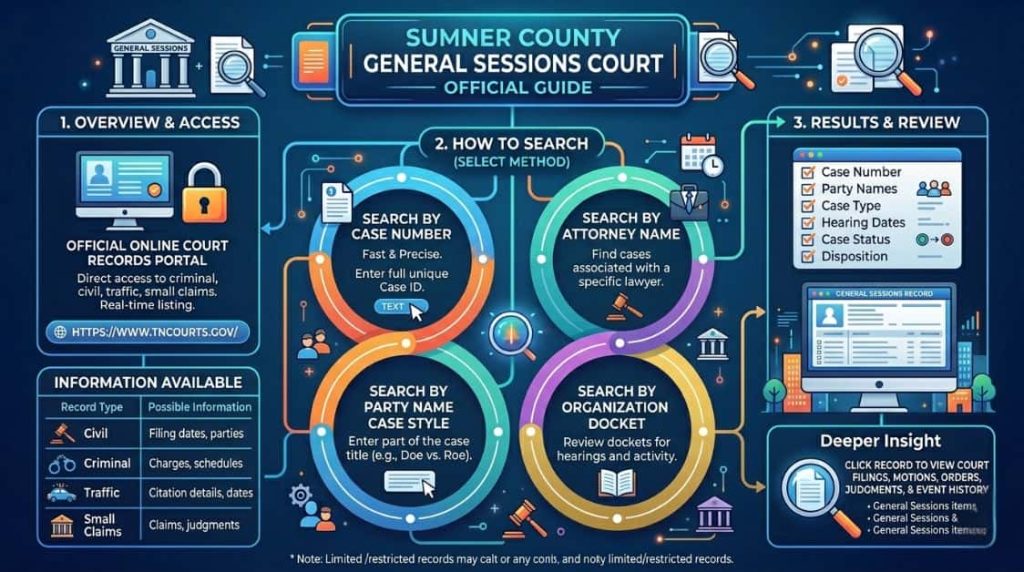
A Sumner County General Sessions Court Case Search may display several types of public record details. The amount of information shown can vary based on court policies, record status, and privacy laws.
Case information may include:
- https://www.tncourts.gov/
- Case number
- Party names
- Case filing date
- Case type
- Hearing dates
- Court location
- Judge assignment
- Case status
- Filed documents
- Disposition information
| Record Type | Possible Information |
|---|---|
| Civil Cases | Filing dates, parties, court actions |
| Criminal Cases | Charges, hearing schedules, case status |
| Traffic Cases | Citation details, court dates |
| Small Claims Cases | Claims filed, judgments, hearing records |
Many users search court records to verify hearing schedules, review case progress, or locate public record information connected to a specific case.
The Case Records
Court records serve as the official record of court proceedings. These records document actions that occur from the initial filing through the final disposition of a case.
Case records often contain:
- Court filings
- Motions
- Orders
- Judgments
- Hearing entries
- Case event history
Some records may have restricted sections. For example, confidential information, sealed records, juvenile matters, and protected personal data may not appear in public searches.
Using Case Search Resources
Several case lookup resources may help users find court records, case information, hearing dates, and docket entries related to Tennessee courts. The Tennessee court system provides public record resources on its official website. Users can begin their search through the Tennessee Courts portal or review available case history resources provided by the Administrative Office of the Courts.
- https://www.tncourts.gov/courts/supreme-court/public-case-history
Search Methods
Users can search available case records using one or more of the following methods:
- Case Number Search
- Enter a known case number to locate a specific court record.
- Party Name Search
- Search by a plaintiff, defendant, petitioner, or respondent name.
- Case Style Search
- Enter part of the case title to locate matching records.
- Attorney Search
- Search using the name of an attorney connected to the case.
- Organization Search
- Search for cases involving a business, government agency, or organization.
- Docket Search
- Review court dockets to check hearing dates, filings, and case activity.
Search Court Records:
| Step | Action |
|---|---|
| 1 | Visit the Tennessee Courts website |
| 2 | Open the Public Case History section |
| 3 | Select a search method |
| 4 | Enter the available case details |
| 5 | Review matching case results |
| 6 | Open the case record or docket entry for more information |
For better results, users should enter accurate information and verify spelling before submitting a search. Narrowing results by case number or party name often produces more precise matches.
Jurisdiction of the Sumner County General Sessions Court
The Sumner County General Sessions Court holds specific legal authority over civil disputes, criminal matters, and traffic violations. This court’s jurisdiction limits the severity of cases and the maximum fines it can impose.
Civil Jurisdiction
In civil cases, the court jurisdiction caps the disputed amount. Currently, the legal authority allows the court to hear cases involving amounts up to $25,000. Civil disputes exceeding this limit must go to a higher court. The judge listens to both sides and renders a binding decision. Plaintiffs often represent themselves in these monetary disputes. The court handles contract breaches and property damage claims within this financial limit.
Criminal Jurisdiction
The court handles preliminary hearings for felony charges. The judicial authority covers criminal matters like misdemeanor cases carrying a maximum sentence of 11 months and 29 days. The judge sets bonds and accepts guilty pleas. Serious felonies move to the grand jury after a preliminary hearing here. The court cannot conduct felony trials, but it plays a major role in the initial stages. Defendants face penalties like jail time, fines, and probation.
Traffic Violation Authority
The Sumner County General Sessions Court processes thousands of traffic tickets each year. The legal authority extends to all state and local traffic infractions. Drivers can contest citations or pay fines directly through the court clerk. Judges decide guilt and assign driving school or penalties. Moving violations like speeding and reckless driving fall under this domain. The court reports convictions to the Department of Safety, which affects driving records.
Small Claims Authority
Small claims fall under the civil jurisdiction umbrella. This section handles cases involving lower dollar amounts, making it easier for everyday citizens to represent themselves. The court provides a straightforward process for filing small claims actions. People can present their evidence directly to the judge without complex legal procedures. The monetary limit for small claims provides an affordable way to settle debts and minor disputes.
Jurisdictional Limits:
- Civil Cases: Up to $25,000
- Misdemeanor Sentences: Maximum 11 months and 29 days
- Small Claims: Specific monetary thresholds apply for simplified filings
| Jurisdiction Type | Maximum Limit | Court Action |
|---|---|---|
| Civil Lawsuits | $25,000 | Full trial and judgment |
| Misdemeanors | 11 months, 29 days | Sentencing and probation |
| Traffic Tickets | State fines | Fine payment or contest |
| Small Claims | Varies by claim | Simplified hearing |
The jurisdiction guarantees the court focuses on community-level issues. Higher courts handle matters beyond these financial and penal boundaries. Judges apply the law strictly within these limits. The structure prevents overcrowding in higher courts. Citizens benefit from this localized, efficient setup.
Types of Cases Heard in the Court
The court hears various legal disputes, ranging from minor criminal charges to significant civil lawsuits. People file cases here for traffic offenses, small claims, and preliminary felony hearings.
Small Claims Cases
Small claims cases offer a fast track for resolving financial disagreements. Plaintiffs sue for owed money, property damage, or breach of contract. The process simplifies legal filings so citizens can represent themselves. The judge reviews the evidence and makes a final decision. These cases involve lower amounts of money. People present receipts, contracts, and photos to support their claims. Lawyers rarely appear in these specific hearings. The informal setting helps people state their cases clearly.
Traffic Offenses
Traffic violations make up a massive portion of the docket. Drivers receive citations for speeding, running red lights, or driving without insurance. Some traffic offenses carry heavy fines and license suspensions. Defendants can argue their case before the judge or pay the ticket beforehand. The court processes DUI charges as well. First-time offenders might face jail time and mandatory classes. The judge reviews officer testimony and driver evidence before ruling.
Misdemeanor Cases
Misdemeanor cases involve less severe criminal charges. Examples include simple assault, petty theft, and first-time DUI offenses. The court can sentence defendants to jail time, probation, or fines. These cases resolve more quickly than felony trials. Defendants have the right to an attorney. If they cannot afford one, the court appoints a lawyer. Judges hold sentencing hearings after a guilty plea or trial. Punishments aim to rehabilitate rather than just punish.
Preliminary Hearings
When police arrest someone for a felony, the case starts here with a preliminary hearing. The prosecutor presents evidence to show probable cause. The judge decides if the evidence supports sending the case to the grand jury. This step filters out weak cases before they reach higher courts. The defense can cross-examine witnesses during this stage. No jury participates in this hearing. The sole purpose involves testing the strength of the prosecution’s evidence.
Civil Disputes
Civil lawsuits cover broader financial conflicts beyond small claims. Landlord-tenant evictions and property damage suits fall into this category. The court hears both sides, reviews contracts, and issues legally binding judgments. These civil disputes provide closure for people and businesses. Plaintiffs seek compensation for broken agreements or unpaid debts. The judge reviews written contracts and listens to witness testimony. The winning party receives a court order for payment or possession of property.
| Case Type | Examples | Possible Outcomes |
|---|---|---|
| Small Claims | Unpaid rent, property damage | Monetary judgment |
| Traffic | Speeding, DUI | Fines, license suspension |
| Misdemeanor | Petty theft, assault | Jail time, probation |
| Preliminary | Felony arrests | Bound over to grand jury |
| Civil Disputes | Evictions, broken contracts | Court orders, payment |
Every case type requires specific filing steps. The clerk provides the necessary paperwork for each distinct category. Judges separate their dockets by case type to maintain efficiency. Morning sessions might focus solely on traffic tickets. Afternoon sessions often handle preliminary felony hearings. This organized approach keeps the court running smoothly. Citizens know exactly when to appear based on their specific charge. The system minimizes wait times and courtroom confusion.
Court Sessions and Hearing Procedures
Court sessions follow strict schedules and formal procedures to maintain order. Attending hearings requires punctuality and an awareness of basic courtroom etiquette.
Scheduling Court Sessions
The clerk sets hearing schedules based on case type and judicial availability. Morning dockets often handle arraignments, though afternoons might feature trials. Missing a scheduled date can lead to severe penalties. Attorneys sometimes file motions to reset hearing dates if conflicts arise. Judges divide their time between criminal and civil matters. The calendar fills up quickly, so early filing often leads to sooner hearings. The clerk publishes the schedule online for easy viewing.
What Happens During Hearings
During judicial proceedings, the judge listens to arguments from both sides. Witnesses testify under oath, and lawyers present evidence. The judge applies the law to the facts and issues a ruling. Some hearings last only a few minutes, and others take hours. The bailiff maintains order in the room. Everyone must rise when the judge enters or exits. The judge asks questions to clarify facts before making a final decision.
Preparing for Court Appearances
Proper preparation makes a significant difference in court. People must dress appropriately and arrive early. Bringing organized documents and evidence helps present a clear argument. Respecting the judge and court staff remains a fundamental rule during all court sessions. Cell phones must stay silent. Weapons are strictly prohibited in the building. Visitors should plan for security screening at the entrance. Finding the right courtroom ahead of time reduces anxiety.
Preparation Checklist:
- Arrive Early: Plan for security lines and parking.
- Dress Code: Wear business casual clothing.
- Documents: Bring original copies and extra sets for the judge.
- Conduct: Address the judge as “Your Honor.”
- Timing: Expect to wait if the docket is busy.
Knowing courtroom procedures removes the mystery from the legal process. People who know the flow feel more confident. The court staff can answer general questions about schedules, though they cannot offer legal advice. Proper behavior guarantees the hearing proceeds smoothly. Outbursts or interruptions result in warnings or even contempt charges. The judge controls the courtroom at all times. Speaking clearly and directly into the microphone creates a clear record. Following these rules guarantees the court hears every side fairly.
Small Claims Process in General Sessions Court
The small claims process provides a simple path for people to resolve minor financial disputes without hiring a lawyer. Plaintiffs file civil claims, and a judge oversees the dispute resolution.
Common Small Claims Matters
People file small claims for various reasons. Unpaid personal loans, security deposit returns, and minor property damage top the list. These disputes usually involve amounts under a specific monetary threshold. The court expects both parties to present their side clearly. Medical bills from minor accidents often end up in this court. Car repair disputes after fender benders appear frequently. The court handles these everyday disagreements efficiently.
Filing a Small Claims Action
Initiating the process requires completing specific legal filings. The plaintiff pays a filing fee and submits a sworn statement detailing the grievance. The court then notifies the defendant of the lawsuit. This notification gives the defendant time to respond. The filing fee varies based on the amount of the claim. The clerk stamps the documents and assigns a case number. The plaintiff must provide a valid address for the defendant to guarantee proper service.
Court Hearings and Outcomes
At the hearing, both parties present their evidence to the judge. The judge listens, asks questions, and delivers a verdict. Court judgments may order one party to pay the other a specific amount. If the losing party refuses to pay, the winner might need to take extra legal steps to collect the money. The judge might award the full amount requested or a lesser sum. Interest on the debt might apply.
Steps to File:
- Complete the civil warrant form.
- Pay the required clerk fee.
- Wait for the defendant to be served.
- Attend the scheduled hearing with evidence.
The dispute resolution method relies on simple facts. The judge looks at contracts, receipts, and photos. Hearsay is generally avoided. The winning party receives a certified judgment from the court. This document allows them to pursue wage garnishment or bank levies if the loser refuses to pay. People often feel nervous before small claims hearings. The informal nature helps calm those nerves. The judge guides the conversation and asks direct questions. No jury participates in these decisions. The judge acts as the sole fact-finder. People state their side, present their proof, and receive a decision the same day. This swift process helps everyone move forward quickly.
Traffic Offenses and Court Procedures
Traffic offenses account for a large portion of the court’s docket, handling everything from speeding tickets to serious moving violations. Drivers must follow specific court procedures to address their traffic citations properly.
Common Traffic Violations
Police issue citations for speeding, reckless driving, and running stop signs. Other common moving violations include failing to yield and following too closely. Each citation carries potential fines and penalties. Some violations add points to a driver’s license. Accumulating too many points leads to license suspension. Driving without valid insurance remains a serious offense. The court requires proof of insurance before dismissing these charges.
Traffic Court Procedures
Drivers have options when dealing with a ticket. They can pay the fine online before the court date. They can appear in court to contest the charge. During court appearances, the officer testifies, and the driver presents a defense. The judge renders a decision based on the testimony. Defendants can subpoena dashcam footage or witnesses. The prosecutor represents the state in these matters. The judge listens to both sides before finding the driver guilty or not guilty.
Court Appearance Expectations
Anyone contesting a ticket must attend their scheduled hearing. Arriving late can result in a default judgment. Drivers should bring evidence like photos or witness statements. The judge expects respect and honesty from everyone in the courtroom. Proper attire shows respect for the court. Drivers must address the judge directly when answering questions. The process moves quickly, so drivers should have their arguments ready.
| Violation Type | Possible Penalty | Court Action |
|---|---|---|
| Speeding | Fine and points | Pay or contest |
| Reckless Driving | Misdemeanor charge | Mandatory appearance |
| No Insurance | Fine and citation | Proof of insurance required |
Misdemeanor Cases and Preliminary Hearings
Misdemeanor cases and preliminary hearings address criminal charges that carry potential jail time. The court conducts a judicial review of felonies and handles lesser offenses from start to finish.
Misdemeanor Court Process
Criminal proceedings for misdemeanors begin with an arraignment. The defendant hears the criminal charges and enters a plea. If the defendant pleads guilty, the judge imposes a sentence immediately. A not-guilty plea leads to a trial where the prosecution must prove the case. Defendants have the right to cross-examine witnesses. The judge sets a trial date during the arraignment. The court appoints a public defender if the defendant cannot afford private counsel.
Preliminary Hearing Overview
Preliminary hearings apply to felony cases. The prosecutor presents enough evidence to establish probable cause that the defendant committed the crime. The defense can cross-examine witnesses. This step acts as a screening process before sending a case to the grand jury. The judge does not decide guilt at this stage. The judge only decides if a reasonable person would believe the defendant committed the crime. If so, the case advances.
Potential Court Outcomes
Several outcomes can result from these hearings. The judge might dismiss the charges if the evidence lacks credibility. The judge could reduce a felony charge to a misdemeanor. If probable cause exists, the case moves forward to the next stage. Defendants might negotiate plea deals with prosecutors. A plea deal often results in reduced charges or a lighter sentence. Some defendants qualify for diversion programs, which erase the charge upon successful completion.
Misdemeanor vs. Preliminary Hearing:
- Misdemeanor: Full trial possible, max sentence 11 months, 29 days.
- Preliminary Hearing: No trial, only probable cause determination, felonies only.
The judicial review guarantees the state has enough evidence to proceed with felony charges. This protects citizens from baseless accusations. The process moves swiftly, protecting the rights of the accused while maintaining public safety. Judges take these hearings very seriously. A person’s liberty hangs in the balance. The prosecution presents police reports and witness statements. The defense challenges weak evidence. If the judge finds probable cause, the case goes to the grand jury. The grand jury then decides on a formal indictment. The entire process relies on checks and balances.
Court Records, Dockets, and Public Information
Court records and dockets provide public access to the details of local legal actions. Citizens can review these public records to find case filings and official legal documents.
Court Records
These files contain the official history of a case. They include indictments, motions, and final orders. The clerk maintains these court records for public viewing. Anyone can request copies of these documents for a small fee. Records detail the exact charges filed against a defendant. They show the chronological timeline of the case. The clerk certifies copies for legal purposes.
Court Dockets
A court docket lists every event scheduled in a case. It shows the dates of filings, hearings, and trials. Attorneys use dockets to track deadlines. The public checks dockets to find out when a specific case will appear before the judge. Dockets update daily to reflect new motions or canceled hearings. The online portal provides instant entry to current schedules.
Public Access Information
Transparency forms the backbone of the legal system. Citizens have the right to view most case filings and legal documents. Some records, like juvenile cases, remain sealed. The clerk’s office provides terminals for on-site searches and online portals for remote viewing. The open records policy builds trust in the local justice system. Citizens stay informed about local judicial actions. The clerk protects sensitive data while providing entry to public facts. Social security numbers and financial account numbers stay hidden from general view. Researchers, journalists, and citizens use these resources daily. The online system provides a convenient way to pull up case details without traveling to the courthouse. Older records might exist on microfilm or in physical books. The staff assists visitors in locating archived files. The commitment to open records guarantees accountability.
Court Forms, Filing Requirements, and Procedures
Submitting the correct court forms guarantees the clerk processes legal paperwork without delays. Following the filing requirements guarantees the court accepts the submissions.
Common Forms
The clerk provides various forms for different needs. Common options include small claims statements, eviction notices, and expungement petitions. Each form requires specific details about the parties involved and the nature of the dispute. The website offers downloadable PDFs for easy printing. Plaintiffs must fill out every required field. Blank spaces can lead to rejected court filings.
Filing Expectations
Filing requirements demand accuracy and completeness. Applicants must sign the documents in front of a notary when necessary. The court rejects incomplete paperwork. Plaintiffs must pay the required filing fees at the time of submission. The clerk stamps the documents with the official filing date. This date matters because statutes of limitations often apply. Missing a deadline by one day can ruin a case.
Important Documentation
Bringing the right legal paperwork prevents wasted trips. Proper identification, evidence copies, and financial records support a case. Organizing court filings before arriving at the courthouse speeds up the process. Proper preparation reflects well on the person filing the motion. Defendants should bring their case numbers to help the clerk find their file quickly.
Form Checklist:
- Completed original form
- Copies for all involved parties
- Payment for filing fees
- Valid photo ID
Proper paperwork keeps the judicial system moving. The clerk cannot give legal advice, so citizens must fill out forms correctly on their own. Third-party websites sometimes offer forms, but the official court website always provides the most up-to-date versions. Using the wrong form wastes time and money.
(FAQs) About the Sumner County General Sessions Court
People frequently ask questions about how the Sumner County General Sessions Court operates. These answers cover common topics regarding court records, misdemeanor cases, and hearing procedures.
What cases are heard in the General Sessions Court?
This court hears civil disputes under $25,000, misdemeanor cases, and traffic offenses. It conducts preliminary hearings for felony charges. The judges resolve landlord-tenant issues and small claims. Any case carrying a sentence of less than one year falls under this court’s authority. The court handles a massive volume of local legal actions daily.
How do small claims cases work?
A plaintiff files a sworn statement and pays a fee. The court notifies the defendant of the claim. Both parties present their evidence at a hearing. The judge makes a final, binding decision without a jury. The process moves faster than formal civil lawsuits. People represent themselves, presenting contracts, receipts, and photos to prove their side.
What is a preliminary hearing?
A preliminary hearing determines if enough evidence exists to send a felony case to the grand jury. The prosecutor presents witnesses, and the judge decides if probable cause exists. This step does not decide guilt or innocence. The defense can cross-examine witnesses. If the judge finds probable cause, the case moves forward to the next stage.
How can court records be accessed?
Anyone can view court records through the online portal or by visiting the clerk’s office. The Sumner County General Sessions Court Case Search tool allows users to find cases by name or case number. Some confidential files remain restricted from public view. The online system provides 24/7 availability for basic lookups.
What traffic offenses may appear before the court?
The court handles all county traffic citations. Common traffic offenses include speeding, driving on a suspended license, and DUI. Running red lights and failure to maintain lane appear frequently. Drivers can pay fines or contest these tickets in court. Serious moving violations carry hefty fines and potential jail time.